DREVO River Cargo Platform L-7 Expand
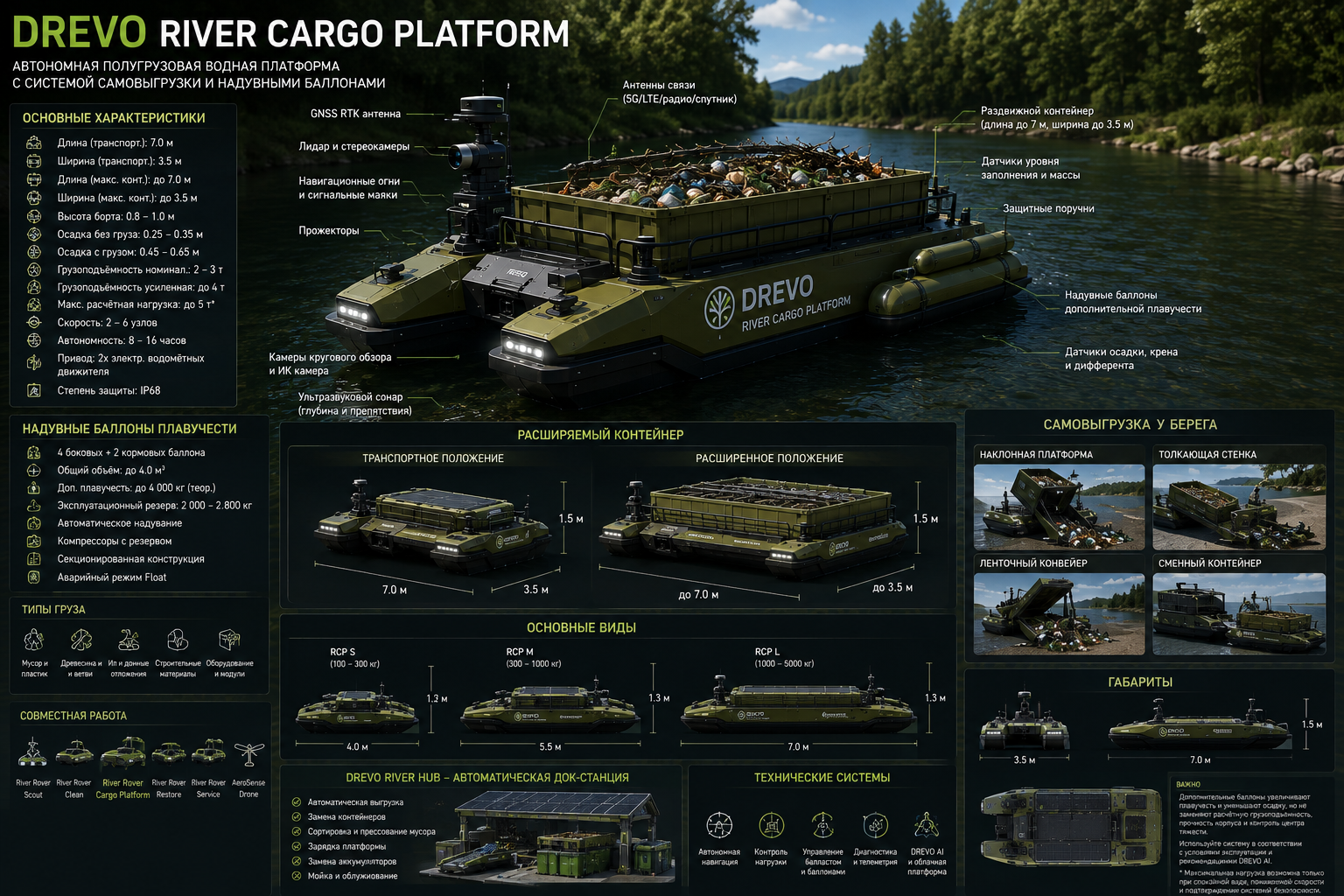
Autonomous semi-cargo water platform with an expandable container and shore self-unloading
1. Purpose
DREVO River Cargo Platform L-7 Expand— an autonomous low-draft cargo platform of the catamaran type, designed for joint operation withDREVO River Rover Clean.
Main tasks:
reception of collected river and coastal waste;
transportation of waste to the coastal station;
independent container unloading;
transportation of wood, branches and plant biomass;
transportation of bottom sediments in sealed containers;
delivery of equipment, batteries and replacement modules;
working as part of a group of autonomous river robots.
The main design feature istelescopically extendable sides and cargo platform, allowing the working size of the container to be changed depending on the nature of the cargo.
2. General architecture
The platform consists of:
two displacement pontoon hulls;
central power frame;
sliding cargo deck;
telescopic container;
electric propulsion system;
autonomous navigation systems;
self-unloading mechanism;
automatic container fastenings;
load and stability control systems.
The catamaran design provides:
increased lateral stability;
slight sediment;
large cargo deck area;
the possibility of placing a container between and above the pontoons;
stability during operation of manipulators and unloading mechanisms.
3. Main dimensions of the platform
Transport position
| Parameter | Design value |
|---|---|
| Total length | 7.0 m |
| Overall width | 3.5 m |
| Height of the pontoons' sides | 0.8–1.0 m |
| Full height without mast | about 1.5 m |
| Full height with navigation mast | 2.4–2.8 m |
| Design draft without cargo | 0.25–0.35 m |
| Design draft at working load | 0.45–0.65 m |
| Minimum working depth | about 0.8 m |
| Cargo deck clearance above water | 0.35–0.55 m |
The size 7.0 x 3.5 m should be considered as the size of the large versionRCP L, and not a compact platform for narrow streams.
4. Expandable cargo container
Basic position
When folded, the container occupies the central part of the platform.
Approximate internal dimensions:
| Parameter | Meaning |
|---|---|
| Length | 1.8-7 m |
| Width | 1.4–3.5 m |
| Side height | 0.8–1.2 m |
| Base area | 2.52–11.5 m² |
| Useful geometric volume | 2–29.4 m³ |
Extended position
Telescopic sections extend in longitudinal and transverse directions.
Maximum external dimensions of the cargo area:
length - up to7.0 m;
width — up to3.5 m;
maximum area of the open cargo area - up to24.5 m².
Important: The container must not occupy the entire platform without access aisles. The actual usable internal area will be less—approximately18–21 m², depending on the thickness of the sides, drives and equipment placement.
At side height:
| Side height | Theoretical volume with an area of 24.5 m² |
|---|---|
| 0.6 m | 14.7 m³ |
| 0.8 m | 19.6 m³ |
| 1.0 m | 24.5 m³ |
| 1.2 m | 29.4 m³ |
These values are geometric. The permissible loading volume is limited not by the container's capacity, but by the cargo's mass, stability, and buoyancy.
5. Expansion mechanism
The container consists of:
central fixed base;
two side telescopic sections;
front and rear retractable sections;
folding or lifting sides;
automatic mechanical locks;
position sensors;
load sensors.
Possible drives:
electromechanical screw actuators;
hydraulic cylinders;
cable-block system;
Electric rack and pinion guides.
For work on water, the following combination is preferred:
mechanical guides;
electromechanical drive;
passive power locks after opening.
The drive does not need to support the load permanently. After expansion, the sections are secured with mechanical pins or wedge locks.
6. Design lifting capacity
For a platform 7 m long and 3.5 m wide, it makes sense to divide the loads into three modes.
Nominal operating mode
payload:2,000–3,000 kg;
continuous operation;
normal maneuverability;
standard speed;
sufficient freeboard.
Enhanced regime
payload:up to 4,000 kg;
reduced speed;
operation on calm water;
limited wind and current;
Mandatory automatic control of roll and trim.
Maximum transport mode
to5,000 kgonly after confirmation by calculations;
short routes;
minimum speed;
lack of excitement;
uniform distribution of load;
work under the control of an operator or shore station.
A 5-ton lifting capacity cannot be guaranteed based solely on external dimensions. It depends on the volume of the pontoons, the weight of the platform itself, the center of gravity, and the required buoyancy.
7. Load distribution
The load must be distributed evenly relative to the longitudinal and transverse axes.
Permissible design loads
| Type of load | Approximate value |
|---|---|
| Uniform load on the cargo deck | 150–250 kg/m² |
| Enhanced uniform load | up to 300 kg/m² |
| Local load on a standard attachment point | 300–500 kg |
| Localized point of strength | up to 1,000 kg |
| Maximum load difference between sides | no more than 10–15% of the total cargo weight |
| Permissible displacement of the load center from the axis | determined by the stability system |
For heavy objects, reinforced areas are provided directly above the cross beams of the power frame.
8. Cargo types and restrictions
Light bulk waste
Examples:
plastic;
bottles;
foam material;
branches;
floating vegetation.
Estimated bulk density:
50–200 kg/m³.
In this case, the container can be filled almost to its geometric volume.
Compacted waste
Estimated density:
200–450 kg/m³.
Total weight control is required even if the container is not completely full.
Wet organics
Estimated density:
500–900 kg/m³.
A 20 m³ container cannot be completely filled with this amount of weight. The permissible filling height is determined by load cells.
Sand, silt and gravel
Estimated density:
wet sludge: 1,100–1,500 kg/m³;
sand: 1,500–1,900 kg/m³;
gravel: 1,600–2,000 kg/m³.
With a lifting capacity of 3 tons, the permissible volume of heavy material is only about 1.5–2.5 m³. Therefore, small sealed containers are used for bottom sediments rather than the entire extended body.
9. Mass control system
The platform is equipped with:
load cells under the container;
draft sensors for each pontoon;
roll and trim sensors;
inertial measurement unit;
load position sensors;
filling control cameras.
DREVO AI calculates:
total mass;
mass distribution;
position of the center of gravity;
freeboard reserve;
permissible speed;
safe route;
the need to redistribute the cargo.
When overloaded, the following are blocked:
further loading;
container expansion;
high speed driving;
independent access to an area with a strong current.
10. Stability
For safe operation it is required:
low battery placement;
placement of heavy equipment inside pontoons;
no heavy loads at the top edge of the container;
symmetrical loading;
automatic filling height limitation;
possibility of ballast correction.
The optional active balancing system includes:
two or four ballast tanks;
electric pumps;
automatic water redistribution;
emergency ballast discharge.
Widening the sides increases the container's area, but does not automatically increase the permissible weight. It is primarily intended forlight bulk cargo.
11. Self-unloading at the shore
The platform approaches the stationWOOD River Huband is fixed with automatic grips.
There are four possible unloading systems.
Inclined body
The cargo platform rises to an angle of 35–50°.
Suitable for:
branches;
organics;
sand;
unsorted waste.
Push wall
The movable shield moves the load to the rear side.
Suitable for uniform and controlled unloading.
Belt conveyor
Moves waste to the shore conveyor.
Suitable for sorting line.
Replacement container
The shore station removes the filled container and installs an empty one.
This is the fastest solution for continuous operation of River Rover Clean.
12. Loads during self-unloading
When the body is tilted, significantly higher local forces occur than during transportation.
Design requirements:
dynamic load factor - not less than 1.3;
the safety factor of the power frame is approximately 1.5–2.0;
fixing the platform to the docking station at least at four points;
prohibition of unloading if the permissible list is exceeded;
control of free movement of cargo;
emergency stop of the lift.
For a load of 3,000 kg, the lifting mechanism is designed for at least the calculated load4,000–4,500 kgtaking into account the dynamics and uneven distribution.
13. The mass of the platform itself
Preliminary assessment:
| Component | Estimated weight |
|---|---|
| Pontoons and power frame | 1,000–1,500 kg |
| Cargo platform and container | 500–900 kg |
| Batteries | 300–700 kg |
| Engines and propulsion systems | 150–300 kg |
| Navigation and electronics | 80–150 kg |
| Unloading mechanism | 250–500 kg |
| Total mass without cargo | about 2,300–4,000 kg |
With a payload of 3,000 kg, the full displacement can be about5.5–7 tons.
For the 5 tonne capacity version, the estimated full displacement may exceed8–9 tons.
14. Propulsion system
Recommended configuration:
two independent electric water-jet propulsion units or protected rudder propellers;
total rated power: 12–30 kW;
separate control of left and right thrusters;
turn almost in place;
protection of propellers from nets and vegetation.
Design speed:
| Mode | Speed |
|---|---|
| Patrol move without cargo | up to 6 knots |
| Working stroke | 3-5 knots |
| Fully loaded | 2-3 knots |
| Approaching the docking station | up to 0.5 knots |
15. Power system
Possible configuration:
LiFePO₄ batteries with a capacity of 80–200 kWh;
Sectioned sealed battery compartments;
low voltage backup circuit;
solar panels for sensors and auxiliary systems;
Automatic shore charging;
quick replacement of battery cartridges.
Autonomy:
8–16 hours depending on load, current and speed;
24/7 operation using multiple platforms and an automatic charging station.
16. Operating conditions
Preliminary operational range:
rivers, canals, lakes and reservoirs;
current speed - preferably up to 1.5–2.0 m/s;
wave height in operating mode - up to 0.3–0.5 m;
air temperature — from −10 to +45 °C;
water temperature - from 0 to +35 °C;
degree of protection of main electrical components - IP67/IP68;
brackish and sea water - only in anti-corrosion version.
17. Main versions
RCP L-7 Waste
For light and mixed waste.
expandable mesh sides;
large capacity;
cargo compaction;
self-unloading.
RCP L-7 Biomass
For vegetation and wood.
reinforced open container;
drainage;
crushing module optional.
RCP L-7 Sediment
For silt and bottom sediments.
airtight small containers;
lowered center of gravity;
Load capacity is more important than volume.
RCP L-7 Equipment
For equipment and modules.
level cargo deck;
attachment points;
a small crane or loading manipulator.
18. Preliminary specification
| Parameter | RCP L-7 Expand |
|---|---|
| Length | 7.0 m |
| Width | 3.5 m |
| Side height | 0.8–1.0 m |
| Draft without cargo | 0.25–0.35 m |
| Draft with cargo | 0.45–0.65 m |
| Platform weight | 2.3–4.0 t |
| Nominal load | 2–3 t |
| Increased load | up to 4 tons |
| Maximum design load | up to 5 tons after engineering confirmation |
| Area of the opened container | up to 24.5 m² external dimensions |
| Real usable area | approximately 18–21 m² |
| Geometric volume | about 15–25 m³ |
| Working speed | 3-5 knots |
| Speed with full load | 2-3 knots |
| Autonomy | 8–16 hours |
| Drivers | 2 independent electric |
| Self-unloading | tilt, pusher, conveyor or interchangeable container |
| Navigation | GNSS RTK, LiDAR, cameras, sonar, IMU |
| Management | autonomous, remote, group |
| Degree of protection | IP67/IP68 |
19. Critical Engineering Requirements
Before producing a prototype, it is necessary to complete:
calculation of total displacement;
calculation of initial and dynamic stability;
determination of the position of the center of gravity;
freeboard calculation;
calculation of longitudinal and transverse strength of the frame;
Container opening load analysis;
calculation of the self-unloading mechanism;
simulation of free movement of cargo;
testing behavior under asymmetric loading;
emergency buoyancy tests in case of damage to one compartment.
Conclusion
DREVO River Cargo Platform L-7 Expandshould be designed not just as a large floating container, but as an autonomous small cargo vessel with intelligent control of mass and stability.
Expandable to fit the dimensions7 × 3.5 mSides provide a significant advantage when transporting light, bulky waste, branches, and plant biomass. For heavier loads—sand, silt, gravel, and metal—the container's working volume must be automatically limited by weight.
A rational base characteristic is the nominal payload2-3 tons, with the possibility of amplification up to4 tons. Meaning5 tonsshould be maintained as a target upper limit, acceptable only after full shipbuilding calculations and prototype testing.