DREVO River Rover Clean
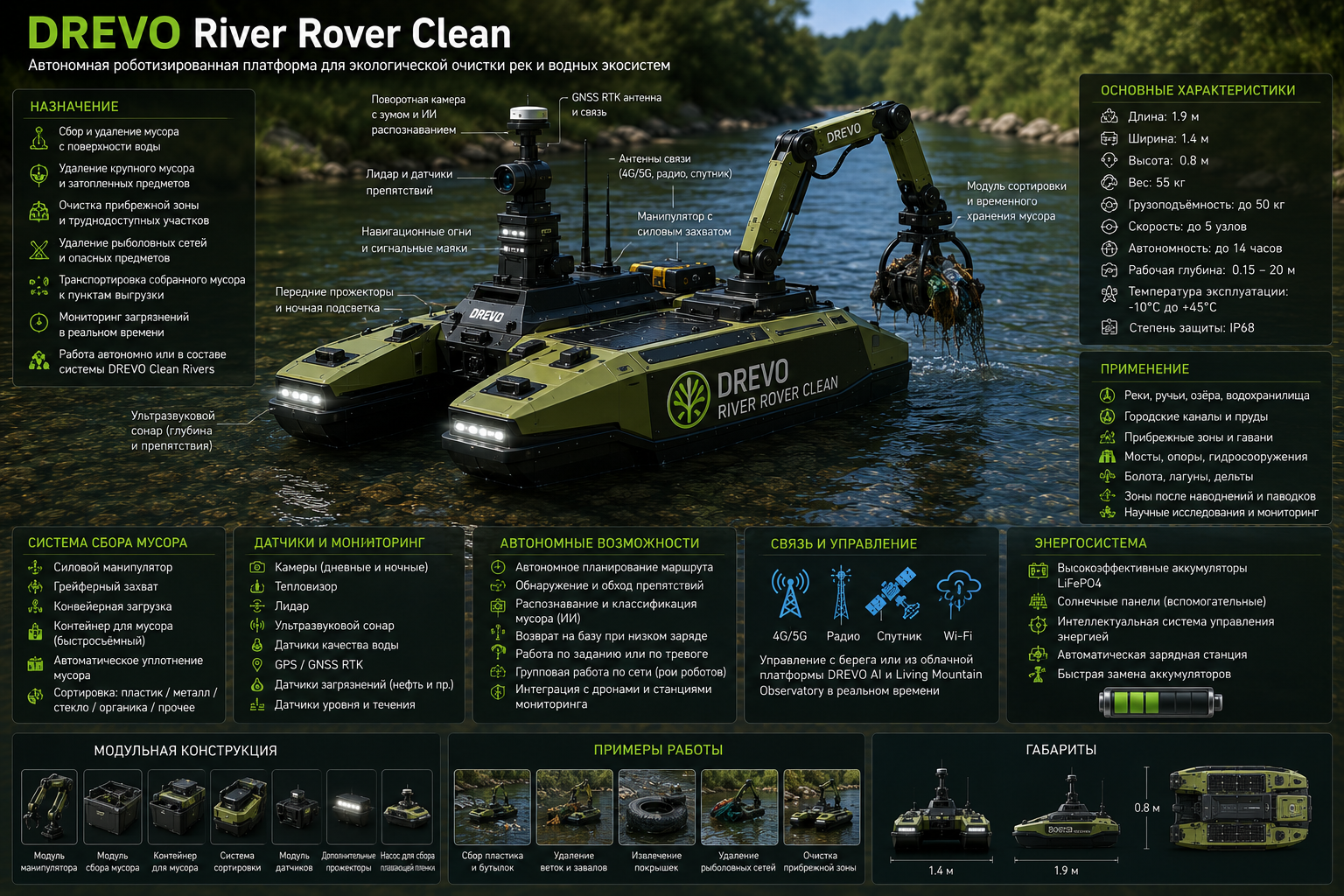
Eco-cleaning robot.
Performed by:
plastic collection;
removal of wood debris;
tire removal;
removal of metal objects;
collection of fishing nets.
DREVO River Rover Restore
Engineering platform.
Used for:
stone laying;
creation of thresholds;
installation of biomodules;
restoration of spawning grounds;
formation of microcascades.
WOOD River Rover Research
Scientific laboratory on the water.
Used for:
sampling;
biological research;
automatic analyses;
long-term monitoring.
Construction
The platform can be released in several versions.
Surface catamaran
For:
rivers;
lakes;
lagoon;
reservoirs.
It is characterized by high stability and low draft.
Amphibious platform
Moves:
on water;
through marshy areas;
in shallow water.
Used in floodplain restoration.
Semi-submersible robot
Intended for:
bottom surveys;
work under bridges;
water quality monitoring.
Navigation
Used:
GNSS RTK;
inertial system;
lidar;
stereo cameras;
sonar;
ultrasonic sensors;
machine vision.
The robot is capable of independently avoiding obstacles.
Manipulators
Installation is possible:
robotic arm;
hydraulic grip;
small capacity bucket;
vacuum pump;
mechanical grab;
devices for installing sensors.
Environmental cleaning
Robot capable of:
remove plastic waste;
remove tires;
collect bottles;
remove metal structures;
clean bridge supports;
remove illegal networks;
clean culverts.
All waste is automatically sorted by material type.
Working with bottom sediments
River Rover performs:
sludge thickness measurement;
composition analysis;
local removal of contaminated areas;
restoration of spawning grounds;
creation of gravel areas.
The work is carried out selectively, without complete destruction of the bottom structure.
Restoration of the riverbed
Robot capable of:
lay boulders;
create stone thresholds;
form microcascades;
place large timber;
install bioengineered structures;
strengthen the banks with natural materials.
Working with vegetation
Used for:
removal of invasive aquatic plants;
planting of native coastal vegetation;
restoration of reed filters;
creation of floating islands.
Removal of invasive species is carried out only in accordance with approved environmental programs.
Science module
Equipped with sensors:
temperatures;
pH;
dissolved oxygen;
electrical conductivity;
turbidity;
chlorophyll content;
nitrates;
phosphates;
oxidation-reduction potential (ORP).
Additional analyzers can be connected if necessary.
Biological monitoring
The system automatically recognizes:
fish;
amphibians;
shellfish;
aquatic plants;
seaweed;
invertebrates.
Cameras and machine vision algorithms are used.
Integration with DREVO AeroSense Drone
The drone detects:
problem area;
coordinates;
type of tasks.
River Rover automatically receives the route and begins work.
Integration with Living Mountain Observatory
Receives data:
water level;
water quality;
flow speeds;
weather conditions.
Transmits back the results of examinations.
Integration with Mountain Digital Twin
After each operation, the digital twin is automatically updated.
The following are recorded:
changes in the riverbed;
completed work;
new objects;
ecological state.
Integration with DREVO AI
Artificial intelligence:
plans routes;
identifies priority areas;
predicts waste accumulation;
assesses the risk of siltation;
calculates the effectiveness of restoration measures.
Energy supply
Possible options:
rechargeable batteries;
replaceable battery modules;
solar panels for powering auxiliary systems;
coastal automatic charging stations.
For long-term missions, automatic docking stations can be used.
Safety
The robot automatically:
avoids collisions;
stops work when people or animals appear in the danger zone;
records emergency situations;
returns to base when battery is low;
transmits alarm messages to the operator.
International integration
DREVO River Rover works in partnership with:
WOOD Clean Rivers;
DREVO Living Mountains;
Mountain Springs Recovery;
Living Mountain Observatory;
Mountain Digital Twin;
TREVO AeroSense Drone;
WOOD AI;
AMCWSRI.
Expected results
Using DREVO River Rover allows you to:
significantly reduce the cost of river monitoring;
perform environmental cleaning without heavy equipment;
identify contamination and damage faster;
reduce the amount of manual labor;
improve the safety of specialists;
accelerate the restoration of riverbeds and coastal ecosystems;
ensure continuous digital monitoring of the state of water bodies.
Promising modules
For further development of the platform, the following may be provided:
Sediment Mapper— three-dimensional mapping of bottom sediments;
Microplastic Collector— collection of microplastics from the surface and in the upper layer of water;
BioSeeder— automatic planting of aquatic plants and coastal vegetation;
River Construction Kit— installation of modular stone thresholds, biomats and ecological reinforcements;
Water Sampling Lab— an automatic laboratory for collecting, storing and preparing water samples.
Project mission
WOOD River Roveris a specialized robotic platform for the projectDREVO Living Mountains, designed to maintain and restore river ecosystems. In combination withLiving Mountain Observatory, Mountain Digital Twin, TREVO AeroSense Drone And WOOD AIIt enables a transition from periodic inspections to continuous ecological river management. The robot doesn't replace natural processes, but rather helps preserve and restore them, performing precise and minimally invasive work from mountain springs to sea estuaries.
DREVO River Rover Clean
Autonomous robotic system for environmental cleaning of rivers, lakes and aquatic ecosystems
Concept
DREVO River Rover Clean (RRC)— a specialized autonomous robotic platform for environmentally friendly cleaning of rivers, streams, lakes, reservoirs, swamps, canals, and coastal areas.
Unlike traditional vessels and earthmoving equipment, River Rover Clean performsselective cleaning, removing only artificial pollutants and hazardous objects, without disturbing the natural structure of the riverbed and animal habitats.
The main principle:
Remove trash, not nature.
Project mission
To create an intelligent system for the continuous purification of inland water bodies, capable of preventing pollution from entering seas and oceans, while simultaneously supporting the natural self-purification processes of rivers.
Main tasks
River Rover Clean is designed for:
collection of floating waste;
removal of sunken waste;
coastal zone cleaning;
removal of fishing nets;
liquidation of the consequences of floods;
cleaning of hydraulic structures;
removal of invasive floating plants;
preparation of sites for ecosystem restoration.
Main areas of application
Used by:
mountain streams;
small rivers;
large rivers;
channels;
lakes;
reservoirs;
wetlands;
lagoons;
deltas;
coastal zones.
Construction
Catamaran
The basic design provides:
high stability;
shallow draft;
ability to work in shallow water;
low resistance to movement;
high load capacity.
Amphibious version
Designed for use:
in wetlands;
in shallow water;
on the coastline;
in floodplains after floods.
Navigation system
Equipped with:
GNSS RTK;
lidar;
stereo cameras;
ultrasonic sensors;
sonar;
inertial navigation system.
The robot independently builds a safe route and avoids obstacles.
Manipulator
The main working tool.
Allows:
pick up trash;
remove tires;
remove plastic products;
remove metal structures;
remove branches;
clean bridge supports;
set up temporary barriers.
Interchangeable grips are used:
universal;
magnetic;
clamshell;
vacuum;
reticulate.
Garbage collection system
The robot is equipped with:
automatic conveyor;
replaceable containers;
pressing system;
sorting module.
Pre-sorting is possible:
plastic;
metal;
glass;
wood;
organic waste.
Working with sunken objects
River Rover Clean is capable of extracting:
car tires;
bicycles;
metal structures;
plastic containers;
fishing nets;
bulky waste.
For heavy objects, joint work with coastal equipment or specialized lifting equipment is envisaged.
Post-flood cleanup
After the floods have passed, the robot:
examines the riverbed;
removes dangerous tree debris;
collects household waste;
clears bridges;
clears culverts.
At the same time, some natural large timber is preserved if it performs important ecological functions and does not pose a risk to infrastructure.
Working with invasive species
The following are removed:
floating invasive plants;
artificially grown algae (if necessary);
polluting biomasses.
The work is carried out in accordance with environmental programs, taking into account the characteristics of local ecosystems.
Environmental control
During operation the following are measured simultaneously:
water temperature;
pH;
dissolved oxygen;
turbidity;
electrical conductivity;
water level;
nitrate content;
phosphate content.
Biological monitoring
The system recognizes:
fish;
birds;
beavers;
amphibians;
aquatic plants;
Red Data Book species.
If sensitive habitats are detected, the robot automatically reduces speed or changes route.
Artificial intelligence
WOOD AI
Automatically:
determines the type of waste;
calculates the optimal route;
predicts waste accumulation sites;
assesses the degree of pollution;
generates reports.
Working together with other robots
River Rover Scout
Conducts reconnaissance.
River Rover Restore
Restores the ecosystem after cleaning.
River Rover Service
Maintains equipment.
TREVO AeroSense Drone
Transmits pollution coordinates.
DREVO Mountain Rover
Works on the shore.
Autonomy
Robot capable of:
patrol routes independently;
work on schedule;
go out on alarm;
automatically return to base;
independently unload containers at a robotic docking station (if the appropriate infrastructure is available).
Energy supply
Used:
rechargeable batteries;
solar panels for powering auxiliary systems;
automatic charging stations;
replaceable battery modules.
Digital integration
All data is received in:
Living Mountain Observatory;
Mountain Digital Twin;
WOOD Clean Rivers;
WOOD AI.
The history of each transaction is stored in a digital archive.
Possible additional modules
Microplastic Collector
Collection of microplastics from the surface and upper layer of water.
Oil Skimmer
Removal of oil products and oil films.
Floating Barrier Deployment
Automatic installation of floating barriers in front of polluted areas or during emergency situations.
BioHarvest
Removal of excess aquatic vegetation biomass followed by processing into compost, biogas or biochar.
Smart Waste Identification
Automatic recognition and classification of waste using computer vision and artificial intelligence.
International integration
River Rover Clean is part of:
WOOD River Rover;
WOOD Clean Rivers;
DREVO Living Mountains;
Mountain Springs Recovery;
Living Mountain Observatory;
Mountain Digital Twin;
TREVO AeroSense Drone;
WOOD AI;
AMCWSRI.
Expected results
Using DREVO River Rover Clean allows you to:
significantly reduce the amount of garbage in rivers;
prevent waste from entering the seas;
reduce plastic pollution;
improve the efficiency of environmental monitoring;
reduce the cost of regular cleaning;
reduce the use of heavy equipment;
preserve the natural structure of riverbeds and banks.
Project mission
DREVO River Rover Cleanis a specialized ecological platform of the systemDREVO Living Mountains, designed for continuous and gentle cleaning of aquatic ecosystems. Together withRiver Rover Scout, River Rover Restore, Living Mountain Observatory, Mountain Digital Twin And WOOD AIIt ensures a transition from one-time cleanup campaigns to continuous river management. This approach allows for the removal of artificial pollutants without disrupting natural processes and prevents their spread throughout the entire watershed—from mountain springs to the seashore.