DREVO River Rover Clean
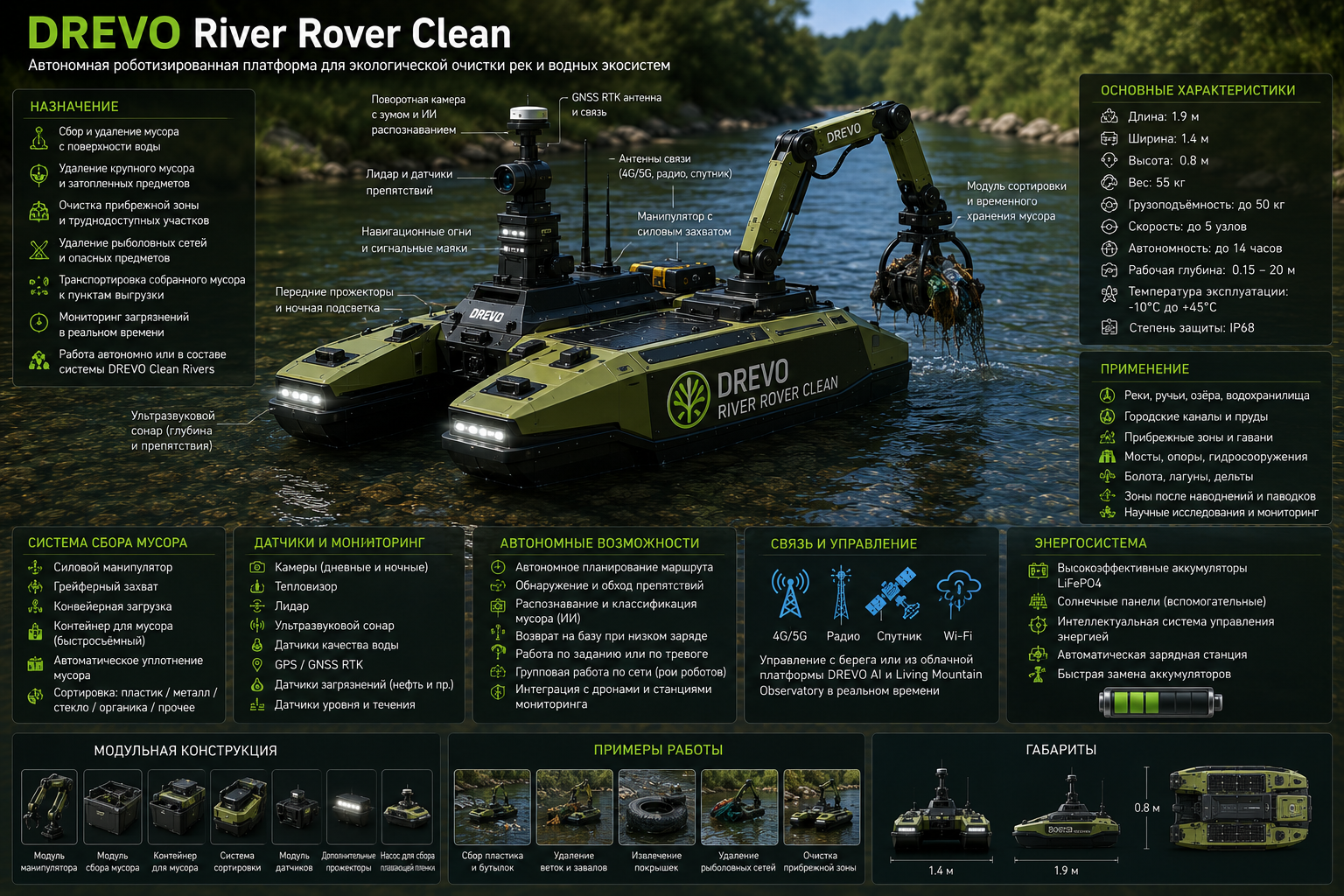
Autonomous system for cleaning rivers, lakes and reservoirs
DREVO River Rover Clean— a robotic multifunctional platform for the comprehensive cleaning of rivers, streams, lakes, and reservoirs. It is designed to operatefrom source to mouth, ensuring the removal of debris, excess silt, wood debris and pollutants with minimal impact on the ecosystem.
In the systemDREVO Living MountainsRiver Rover Clean is one of the main tools for watershed restoration.
The main task is not just to collect garbage, but to restore the river to its natural self-purification processes.
Main tasks
Cleaning the water surface.
Cleaning of the water column.
Cleaning the bottom.
Removal of plastic waste.
Collection of wood debris.
Raising sunken timber.
Removal of excess sludge.
Search for scrap metal.
Extraction of tires.
Collection of construction waste.
Cleaning of spawning grounds.
Restoration of the natural riverbed.
River Rover Clean Family
| Model | Purpose |
|---|---|
| Clean Mini | Springs, streams, narrow canals |
| Clean S | Small rivers |
| Clean M | Middle rivers |
| Clean L | Large rivers and lakes |
| Clean XL | Reservoirs, ports, deltas |
Main modules
Surface Cleaning Module
Removes:
plastic;
bottles;
wood;
leaves;
foam plastic;
algal clusters;
oil films (using specialized sorbents).
Underwater Cleaning Module
Works:
below the surface;
along the banks;
near the snags;
around the stones.
Removes:
garbage;
networks;
cables;
plastic.
Bottom Recovery Module
Intended for:
removing debris from the bottom;
restoration of spawning grounds;
clearing stone channels.
Working tools:
soft grips;
vacuum collector;
hydraulic manipulators;
magnetic separator for ferromagnetic objects.
Sediment Management Module
Used for:
removal of excess sludge;
depth restoration;
cleaning of spring outlets.
It operates with adjustable suction power to avoid damaging the natural structure of the bottom as much as possible.
Timber Recovery Module
Search:
bog wood;
large logs;
sunken trunks.
The lift is carried out:
winches;
inflatable lifting cylinders;
floating platforms DREVO River Cargo Platform.
Metal Recovery Module
Used to search:
scrap metal;
anchors;
pipes;
chains;
bicycles;
techniques.
Tools:
magnetic grippers;
mechanical pliers;
underwater cameras.
Unique technical solutions
Adaptive Eco Intake
The suction system automatically reduces power when it detects:
fish;
amphibians;
large invertebrates;
plants.
Smart Sediment Separation
The extracted material is divided into:
open;
sand;
gravel;
wood;
metal;
plastic;
organic remains.
Living Bottom Mode
When working in ecologically valuable areas, the system preserves:
large boulders;
natural driftwood;
spawning areas;
colonies of bivalve mollusks;
root systems of coastal plants.
Floating Cargo Connection
All heavy materials are automatically transferred to:
DREVO River Cargo Platform;
floating containers;
coastal stations.
Navigation
Used:
RTK GNSS;
inertial navigation;
LiDAR;
population;
sonar;
stereo cameras;
underwater cameras.
Artificial intelligence
DREVO AI recognizes:
plastic;
wood;
metal;
open;
spawning grounds;
driftwood;
boulders;
rare plants;
animals.
The safest method of operation is selected for each object.
Working with silt
Silt is classified into categories:
| Category | Action |
|---|---|
| Pure mineral | Return to restoration projects or use in reclamation after analysis |
| Organic | Composting or use after safety assessment |
| Contaminated | Transfer to specialized processing or disposal |
| Historically contaminated | Isolation and handling according to environmental safety requirements |
Working with wood
The material is automatically divided:
fresh wood;
natural deadwood;
large blockages;
bog wood;
wood for DREVO Timber Reserve;
wood for processing.
Working with plastic
Separation:
PET;
HDPE;
PP;
films;
fishing nets;
mixed plastic.
Working with metal
Sorting:
steel;
cast iron;
aluminum;
copper;
stainless steel.
Handling biological waste
The following stand out:
seaweed;
reed;
rug;
leaves;
wood remains.
Possible directions:
compost;
biogas;
mulch;
biofertilizers.
Integration with the DREVO system
| System | Purpose |
|---|---|
| River Rover Scout | Preliminary route survey |
| River Rover Restore | Restoration of riverbeds after cleaning |
| River Cargo Platform | Transportation of extracted materials |
| Living Mountain Observatory | Water quality and work efficiency control |
| Mountain Digital Twin | Map of cleared areas and change history |
| WOOD AI | Route planning, pollution analysis and work prioritization |
| TREVO AeroSense Drone | Discovery of new airborne pollutants |
Stages of work
Aerial photography and survey.
Digital pollution mapping.
Surface cleaning.
Cleaning of the underwater area.
Cleaning the bottom.
Sorting materials.
Restoration of the riverbed and spawning grounds.
Water quality control.
Long-term monitoring.
Expected results
reducing the amount of garbage in rivers;
restoration of the natural course;
improving water quality;
restoration of spawning grounds;
reducing the risk of local traffic jams and flooding;
return of valuable materials to economic circulation;
biodiversity conservation;
support long-term watershed restoration.
The main principle
DREVO River Rover Clean cleans the river while preserving its living structure.
Instead of total mechanical clearing, the system usesselective, environmentally oriented approach, in which pollution and dangerous obstacles are removed, and natural elements - boulders, part of the fallen tree trunk, root systems, spawning grounds and habitats of aquatic organisms - are preserved, whenever possible, as the basis of a healthy river ecosystem.