Technical solutions for the DREVO River Rover Restore S
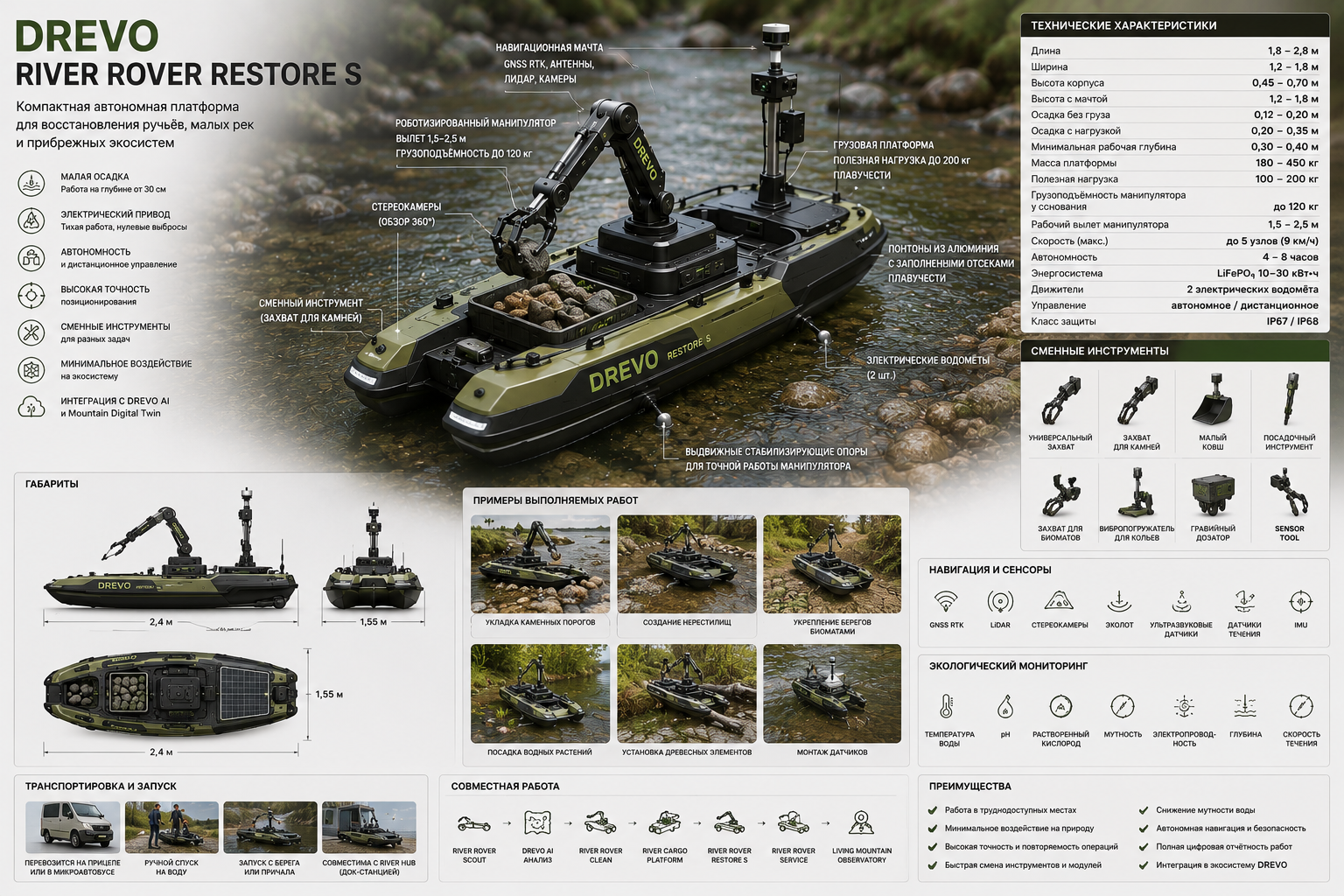
Compact robotic platform for stream and small river restoration
1. Basic engineering concept
DREVO River Rover Restore SIt would be advisable to create it not as a scaled-down water excavator, but as a lightweight modular platform that could perform precise recovery operations.
Basic engineering principles:
shallow draft;
low center of gravity;
catamaran layout;
electric drive;
modular manipulator;
replaceable tools;
automatic stabilization;
possibility of amphibious execution;
work without destroying the bottom and banks.
The main goal of the first prototype was not maximum power, but reliability, precision and ease of maintenance.
2. Recommended basic configuration
For the first prototype the following version is proposed:
DREVO River Rover Restore S-250
Main parameters:
| Parameter | Design value |
|---|---|
| Length | 2.4 m |
| Width | 1.55 m |
| Body height | 0.55 m |
| Unladen weight | 280–380 kg |
| Payload | up to 250 kg |
| Draft without cargo | 0.15–0.18 m |
| Draft with cargo | 0.25–0.32 m |
| Working depth | from 0.35 m |
| Speed | up to 4 knots |
| Autonomy | 5–10 hours |
| Working reach of the manipulator | up to 2 m |
| Load capacity of the manipulator | 50–100 kg |
3. Body
Catamaran scheme
Two independent pontoons are used.
Advantages:
high lateral stability;
the ability to place the instrument between the housings;
shallow draft;
stability during boom operation;
the possibility of replacing one pontoon;
easy transportation.
Pontoons materials
There are three main possible solutions.
Aluminum body
Recommended option for the first industrial prototype.
Advantages:
high strength;
maintainability;
light weight;
impact resistance;
Possibility of welding production.
Recommended material:
marine aluminum alloy;
the thickness of the outer sheet is approximately 3–5 mm;
internal partitions every 400–700 mm.
HDPE polyethylene
Suitable for the light version.
Advantages:
impact resistance;
corrosion resistance;
easy maintenance.
Flaws:
it is more difficult to attach the power frame;
higher deformation;
It is more difficult to perform precision repairs.
Composite
Suitable for serial production.
Advantages:
light weight;
complex hydrodynamic shape;
no corrosion.
Flaws:
more expensive production;
complex repairs in the field.
For the first prototype, it is more rational to use aluminum.
4. Power frame
A spatial frame is installed between the pontoons.
It bears loads from:
manipulator;
cargo;
stabilizing supports;
tools;
batteries;
wave movements;
impact with an obstacle.
Recommended design:
aluminum or steel power frame;
cross beams;
central platform of the manipulator;
four reinforced points for stabilizers;
Modular mounting guides.
For the manipulator unit, it is advisable to use a separate steel subframe, isolated from the aluminum body.
5. Central working channel
An open working channel of approximately: width should be left between the pontoons:
0.45–0.70 m.
Through it you can:
lower the bucket;
install plants;
lay gravel;
place sensors;
work with the bottom;
carry out visual inspection.
This channel allows you to work directly under the center of the platform, where the risk of tilting is minimal.
6. Propulsion system
Basic option
Two independent electric water jets.
Advantages:
no exposed screw;
protection of fish and animals;
resistance to grass and branches;
high maneuverability;
the turn is almost on the spot.
Recommended power:
2 × 1.5–3 kW.
Alternative
Protected electric outboard motors.
Advantages:
accessibility;
easy replacement;
low price of the prototype.
Flaws:
risk of grass and nets getting tangled;
higher vulnerability of the propeller.
For small streams, water cannons are preferable.
7. Power system
Batteries
It is recommended to use LiFePO₄.
Advantages:
high fire safety;
long service life;
stable voltage;
resistance to cyclic loading.
Estimated capacity:
20–40 kWh.
It is recommended to divide the power system into two independent circuits.
Movement contour
Nourishes:
water cannons;
navigation;
connection.
Outline of working mechanisms
Nourishes:
manipulator;
pumps;
actuator;
tools.
This way, the failure of one circuit will not completely immobilize the platform.
8. Replaceable battery cartridges
It is advisable to place batteries in two or four removable cassettes.
Advantages:
quick replacement;
convenient service;
possibility of charging separately;
mass balancing;
reservation.
The cassettes are placed low inside the pontoons to lower the center of gravity.
9. Manipulator
Recommended design
Compact electrohydraulic manipulator with three or four degrees of freedom.
Main parameters:
| Parameter | Meaning |
|---|---|
| Working radius | 1.5–2.0 m |
| Load at the base | 80–100 kg |
| Cargo at full capacity | 30–50 kg |
| Turn | 270–360° |
| Weight | 60–120 kg |
| Accuracy | about 20–50 mm |
Why not fully hydraulic?
Classic hydraulics are powerful, but:
heavy;
requires a pumping station;
creates a risk of oil leakage;
more difficult to maintain.
Rational solution:
electric drives of main joints;
Compact hydraulics for gripping or heavy tools only.
10. Quick-change tool interface
A universal automatic clutch is installed at the end of the manipulator.
She conveys:
mechanical load;
power supply;
digital signal;
hydraulic pressure if necessary.
Tool change can be performed:
automatically at the shore station;
manually;
by the River Rover Service robot.
11. Basic working tools
Universal grab
Used for:
stones;
wood;
biomat;
containers.
Small ladle
Volume:
10–30 liters.
Used for local work only.
Capturing stones
Has soft or replaceable sponges.
Allows you to lay stones accurately.
Gravel dispenser
It is a small bunker with an adjustable damper.
Used to create spawning grounds.
Planting auger
Creates a small hole in the soil and places the plant.
Vibratory stake setter
Used for:
biomat fastenings;
installation of wooden anchors;
creation of fascines.
Biomat Capture
Unwinds and fixes rolled material.
Hydroseeding module
Includes:
small tank;
pump;
spray nozzle;
mixer.
12. Platform stabilization
Operating a manipulator without stabilization is dangerous.
It is recommended to use four systems simultaneously.
Retractable bottom supports
Four telescopic stands.
They:
rest against the bottom;
unloading pontoons;
reduce pitching;
fix the platform.
Working stroke:
approximately 0.5–1.5 m.
Lateral inflatable bladders
They are placed along the pontoons.
Used:
when operating the manipulator;
with uneven load;
in an emergency.
Active ballast
Small ballast tanks are placed inside the pontoons.
The pumps redistribute water between the left and right sides.
Electronic departure restriction
The system automatically limits the movement of the manipulator in case of dangerous tilt.
13. Stability sensors
The platform is equipped with:
dual-channel IMU;
roll sensors;
trim sensors;
precipitation sensors;
pressure sensors in the supports;
manipulator strain gauges;
cargo deck load sensors.
DREVO AI calculates the permissible working radius in real time.
14. Navigation
Basic set:
GNSS RTK;
NOSE;
LiDAR;
stereo cameras;
ultrasonic sensors;
sonar;
depth sensor;
current speed sensor.
Working without GNSS
In forested gorges, the satellite signal may be unstable.
Therefore, the platform must use:
visual odometry;
LiDAR SLAM;
coastal lighthouses;
local radio tags;
digital map of the riverbed.
15. Cameras
It is recommended to install:
front RGB camera;
rear camera;
two side cameras;
camera on the manipulator;
underwater camera;
Thermal imager optional.
The camera on the tool is especially important for precise placement of stones and planting of plants.
16. Sonar and bottom mapping
For the compact version it is enough:
single-beam echo sounder;
side sonar in an extended version;
depth sensor;
underwater camera.
The system builds:
bottom profile;
obstacle map;
sediment map;
map of completed work.
17. Environmental sensors
Basic set:
water temperature;
pH;
dissolved oxygen;
electrical conductivity;
turbidity;
ORP;
flow speed.
Optional:
nitrate;
phosphate;
chlorophyll;
ammonium;
petroleum products.
18. Turbidity control
During bottom work the system should automatically:
measure the initial turbidity;
turn on the working tool;
control the train;
reduce the tool speed;
stop work when the threshold is exceeded.
To localize suspended matter, you can use:
small floating screens;
bottom screens;
temporary filter mats.
19. Modular cargo compartment
The cargo compartment is made in the form of a replaceable cassette.
Options:
stone container;
gravel container;
plant cassette;
biomat rolls;
tool container;
scientific module;
battery module.
Fixation:
four automatic locks;
guides;
electrical connector;
RFID identification of the module.
20. Amphibious version
For swamps and very shallow areas, a removable chassis can be used.
Options:
Mini caterpillars
They are installed on the sides of the pontoons.
Advantages:
movement through silt;
going ashore;
high thrust.
Screw propellers
Suitable for swamps, but may have a greater impact on the soil.
Retractable wheels
A simple option for descending and exiting onto solid shore.
For the first prototype, it is more rational to use removable electric track modules.
21. Shore docking station
DREVO River Hub S must provide:
charging;
battery replacement;
change of tools;
loading materials;
waste unloading;
sink;
diagnostics;
data transfer.
For small rivers, the station can be designed as a mobile trailer.
22. Software architecture
The control system consists of several levels.
Safety Controller
Responsible for:
emergency stop;
roll limitation;
drive protection;
return to base.
Navigation Controller
Responsible for:
route;
holding position;
obstacle avoidance;
moving against the current.
Manipulator Controller
Manages:
hand trajectory;
tool;
limiting the effort;
compensation for pitching.
Mission Controller
Receives a task from DREVO AI.
For example:
install 12 stones;
lay 8 m of biomat;
plant 40 plants;
install the sensor.
23. Control modes
Fully autonomous
For repeatable operations.
Controlled autonomy
The robot performs actions automatically, the operator confirms critical stages.
Remote control
For difficult conditions.
Manual service control
Used for repair and adjustment.
On the first prototype the main mode should be:
controlled autonomy with the possibility of full remote interception.
24. Communication
Main channels:
4G/5G;
Wi-Fi;
industrial radio communication;
Satellite channel optional.
If connection is lost, the robot:
completes safe movement;
folds the manipulator;
lifts the instrument;
returns to the checkpoint;
saves data locally.
25. Security
Mandatory systems:
physical emergency button;
Remote emergency stop;
limiting the force of the manipulator;
recognition of people and animals;
protection of movers;
automatic boom folding;
emergency buoyancy cylinders;
backup communication battery;
light and sound signals.
26. Recommended ready-made components
For the first prototype, it makes sense to use ready-made industrial components:
electric water cannons;
Marine GNSS RTK receivers;
industrial LiDAR;
sealed stereo cameras;
ready-made compact manipulator;
LiFePO₄ battery modules;
electric linear actuators;
industrial controllers;
ready-made water quality sensors.
In-house development should focus on:
power frame;
stabilization system;
quick-change tools;
software integration;
adaptation to river conditions.
27. Stages of prototyping
Stage 1. Floating chassis
Create:
pontoon;
frame;
propulsion;
batteries;
basic navigation.
Step 2. Remote control
Check:
maneuverability;
sediment;
stability;
movement in the current.
Stage 3. Manipulator
Install:
arrow;
capture;
load cells.
Stage 4. Stabilization
Add:
supports;
cylinders;
roll control.
Stage 5. The first working tool
It is recommended to start with a universal grip.
Stage 6. Automation
Add:
holding position;
restriction of the working area;
semi-automatic stone laying.
Stage 7. Environmental tools
Add:
landing module;
gravel dispenser;
biomats.
28. Rational version of the first prototype
The first prototype should not include all features at once.
Optimal configuration:
aluminum catamaran;
length 2.4 m;
width 1.55 m;
two water jets of 2 kW each;
battery 25–30 kWh;
manipulator up to 80 kg at the base;
universal grip;
four bottom supports;
GNSS RTK;
cameras;
simple echo sounder;
roll sensors;
remote control;
semi-automatic position holding.
Such a prototype will already be able to:
lay stones;
move branches;
install biomats;
place sensors;
carry out minor restoration work.
29. Main technical risks
Critical project risks:
the manipulator is too heavy;
high center of gravity;
insufficient frame rigidity;
loss of stability when the arrow is launched;
winding of vegetation on propellers;
poor GNSS performance under forest;
damage to the hull from stones;
excessive complexity of the first version;
water ingress into electronics;
water contamination with hydraulic fluid.
Therefore, the first prototype should be as simple as possible and designed to work with objects weighing up to 50–80 kg.
Conclusion
The most realistic technical solution forDREVO River Rover Restore S— a compact aluminum catamaran with two electric water jets, low-mounted batteries, a small manipulator, four stabilizer legs, and modular instruments.
The platform's strength should not lie in lifting heavy objects, but in its ability to autonomously perform hundreds of precise operations:
lay small stones;
install wooden elements;
distribute gravel;
secure biomats;
plant plants;
install sensors.
This approach allows us to create a truly working prototype without excessive weight, cost, or technical complexity.