DREVO River Rover Restore L
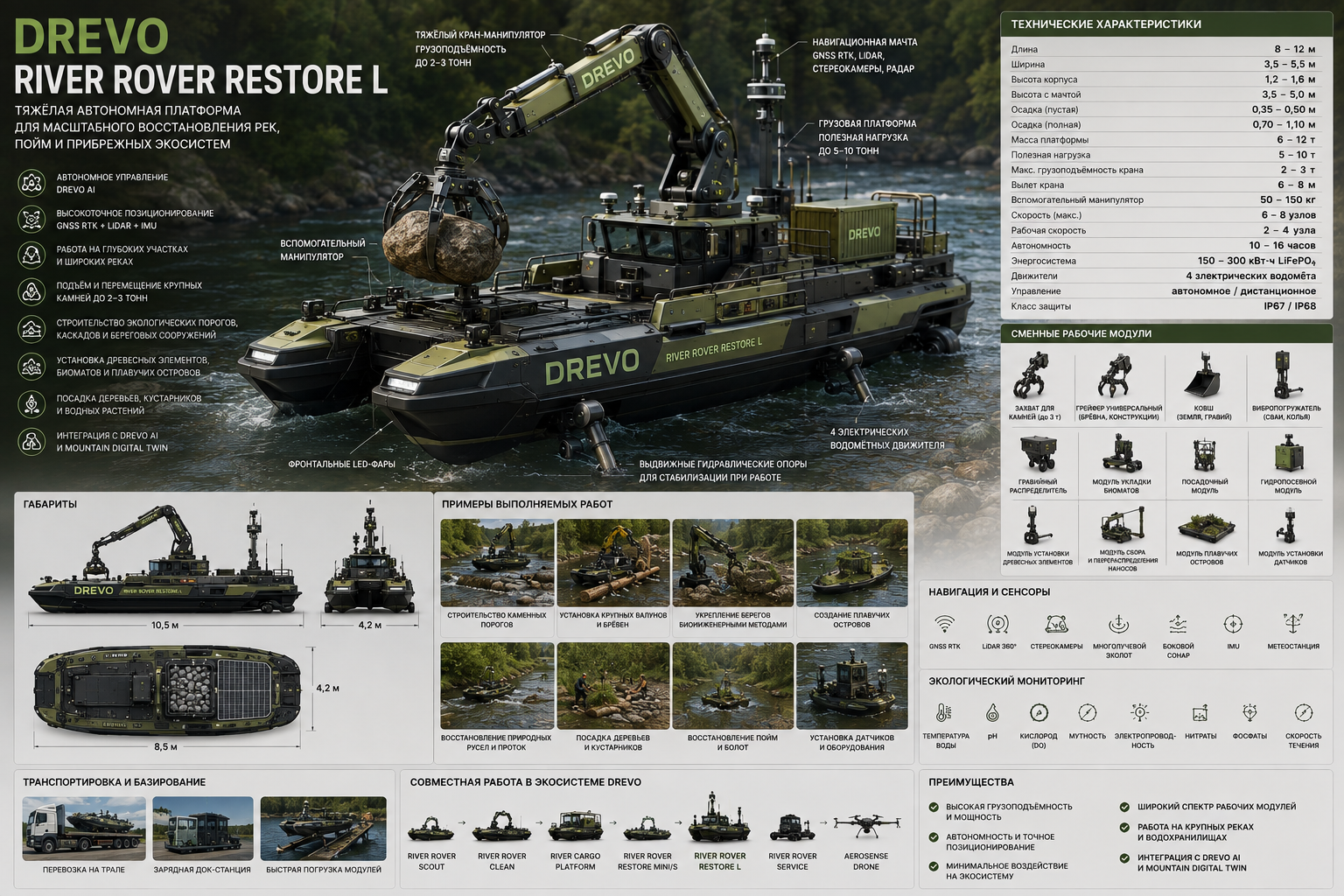
A heavy-duty autonomous robotic platform for the engineering restoration of rivers, floodplains, and coastal ecosystems.
Concept
DREVO River Rover Restore L (RRR-L)— a heavy autonomous engineering platform designed to carry out large-scale environmental restoration work on large rivers, lakes, reservoirs, floodplains, and deltas.
Restore L is the most powerful representative of the familyRiver Rover Restoreand is capable of performing work that today requires the use of excavators, floating cranes, barges and specialized construction vessels.
The main feature of the platform is the combination of high load capacity, autonomous navigation, robotic manipulator and digital control throughWOOD AI And Mountain Digital Twin.
The main principle:
Heavy restoration work with minimal impact on the ecosystem.
Main tasks
The platform is designed for:
restoration of large river channels;
construction of cascades and ecological rapids;
restoration of floodplains;
creation of spawning complexes;
placement of large boulders;
installation of wooden hydraulic structures;
restoration of wetlands;
creation of new river branches;
construction of floating swamps;
formation of filtration zones;
installation of engineering modules of the Living Mountain Observatory.
Main areas of application
Used by:
large rivers;
wide mountain valleys;
lakes;
reservoirs;
floodplains;
deltas;
estuary;
lagoons;
coastal zones.
Platform architecture
Restore L is built using a heavy catamaran design.
The layout includes:
two large displacement pontoons;
central heavy-duty power frame;
cargo deck;
heavy-duty robotic crane;
auxiliary manipulator;
container system;
hydraulic stabilizers;
ballast tanks;
power plant;
automatic positioning system.
Main dimensions
| Parameter | Design value |
|---|---|
| Length | 8–12 m |
| Width | 3.5–5.5 m |
| Body height | 1.2–1.6 m |
| Height with mast | 3.5–5 m |
| Draft without cargo | 0.35–0.50 m |
| Draft at full load | 0.70–1.10 m |
| Platform weight | 6–12 t |
| Payload | 5–10 t |
Power structure
The basis of the platform is a welded spatial frame.
Materials:
marine aluminum alloy;
high-strength structural steel in high-load areas;
anti-corrosion protection.
The frame is calculated for:
lifting heavy boulders;
crane operation;
container transportation;
dynamic loads during waves.
Cargo deck
Usable area:
15–30 m².
Intended for:
boulders;
gravel;
wood;
containers;
engineering modules;
building materials;
plants.
Standard container mounts and guides are provided for quick replacement of modules.
Robotic crane-manipulator
The main working tool of the platform.
Design specifications:
| Parameter | Meaning |
|---|---|
| Maximum reach | 6–8 m |
| Load capacity at base | 2–3 t |
| Load capacity at full reach | 500–1,000 kg |
| Angle of rotation | 360° |
| Number of degrees of freedom | 6–7 |
Used:
automatic pitch compensation;
load limitation;
digital model control;
semi-automatic laying mode.
Auxiliary manipulator
Used for:
planting of plants;
installation of sensors;
installation of biomats;
precision operations.
Load capacity:
50–150 kg.
Replaceable working modules
The platform supports automatic tool replacement.
Stone Placement Module
Laying boulders weighing up to 2–3 tons.
Eco Weir Builder
Installation of environmental thresholds.
Log Placement Module
Placement of large logs and root systems.
Gravel Distributor
Creation of spawning grounds.
Sediment Recovery Module
Local redistribution of sediments without large-scale deepening of the riverbed.
BioMat Installation Module
Installation of biomats and coconut rollers.
Planting Module
Planting of trees, shrubs and coastal vegetation.
Floating Habitat Builder
Assembly and installation of floating islands.
Sensor Deployment Module
Installation of Living Mountain Observatory equipment.
Restoration of the riverbed
The platform is capable of:
to form new bends in the riverbed;
create rolls;
build pools;
install boulder ridges;
restore floodplain channels;
create side channels;
form sediment accumulation zones.
All work is carried out using a digital model.Mountain Digital Twin.
Ecological thresholds
Restore L builds:
cascading rapids;
fish passage structures;
flow distributors;
stone ridges;
anti-erosion structures.
Each object is hydraulically modeled prior to construction.
Working with large timber
The platform installs:
tree trunks;
root systems;
tree islands;
fish shelters;
natural flow retardants.
All elements are fixed using environmentally friendly anchor systems.
Restoration of floodplains
The platform performs:
restoration of seasonal flooding;
closure of artificial canals;
creation of new reservoirs;
restoration of swamps;
formation of filtration zones;
creation of habitats for birds and amphibians.
Bioengineered coastal strengthening
Used:
boulders;
wood;
living willow structures;
coconut rollers;
geogrids;
biomats;
local vegetation.
Rigid concrete structures are used only in exceptional cases.
Planting operations
Restore L is capable of planting:
large trees;
shrubs;
marsh plants;
coastal grasses;
aquatic vegetation.
Automatic feed is possible:
compost;
mycorrhiza;
biochar;
organic fertilizers;
water-retaining substrates.
Stabilization system
When working with a heavy manipulator, the following are used:
Retractable hydraulic supports
Fix the platform relative to the bottom.
Ballast system
Automatic redistribution of water between pontoons.
Inflatable side bladders
Additional buoyancy and increased lateral stability on heavy climbs.
Active roll control system
Uses:
NOSE;
pressure sensors;
precipitation sensors;
boom load cells.
Propulsion system
Suggested configuration:
four electric water jet propulsion units;
independent management of each;
Dynamic Positioning.
Total power:
60–120 kW.
Maximum speed:
6–8 knots.
Working speed:
2–4 knots.
Energy system
Used:
LiFePO₄ batteries;
modular battery packs;
Automatic shore charging;
Possibility of connection to the shore power grid.
Capacity:
150–300 kWh.
For long-term operations, a hydrogen fuel cell or diesel-electric generator can be integrated as a range extender if operating conditions require it.
Navigation
Used:
GNSS RTK;
LiDAR;
multibeam echo sounder;
side sonar;
stereo cameras;
thermal imager;
NOSE;
visual navigation;
automatic position holding.
Environmental sensors
Controlled by:
water temperature;
pH;
oxygen;
turbidity;
electrical conductivity;
ORP;
nitrate;
phosphate;
flow speed;
depth.
Integration with other robots
Restore L works in conjunction with:
River Rover Scout- reconnaissance;
River Rover Clean- cleaning;
River Cargo Platform— delivery of materials;
River Rover Service— equipment maintenance;
TREVO AeroSense Drone- aerial mapping;
Living Mountain Observatory— monitoring;
Mountain Digital Twin— digital modeling;
WOOD AI- planning and management.
Safety
The platform automatically:
limits the working area of the crane;
stops lifting when the list is dangerous;
controls load distribution;
recognizes people and animals;
avoids collisions;
folds equipment in case of an accident;
switches to safe mode when systems fail.
Preliminary specification
| Parameter | River Rover Restore L |
|---|---|
| Length | 8–12 m |
| Width | 3.5–5.5 m |
| Weight | 6–12 t |
| Payload | 5–10 t |
| Draft | 0.35–1.10 m |
| Main manipulator | up to 2–3 tons |
| Working flight | 6–8 m |
| Auxiliary manipulator | 50–150 kg |
| Speed | up to 6–8 knots |
| Autonomy | 10–16 hours |
| Batteries | 150–300 kWh LiFePO₄ |
| Drivers | 4 electric water jets |
| Management | autonomous, remote, semi-automatic |
| Navigation | RTK, LiDAR, multibeam echo sounder, sonar, cameras |
Application stages
Typical work cycle:
River Rover Scoutsurveys the area.
WOOD AIforms a restoration project.
River Rover Cleanremoves dirt.
River Cargo Platformdelivers materials.
River Rover Restore Lperforms difficult reconstructive surgeries.
River Rover Serviceinstalls sensors and maintains infrastructure.
Living Mountain Observatorycontrols changes.
Mountain Digital Twinupdates the digital model and evaluates the project's effectiveness.
Project mission
DREVO River Rover Restore L— the system's flagship engineering platformDREVO Living Mountains, designed for large-scale restoration of river ecosystems without traditional heavy intervention. It combines robotics, digital modeling, ecological engineering, and autonomous control, enabling complex hydraulic engineering and environmental restoration work to be carried out with high precision and minimal environmental impact.